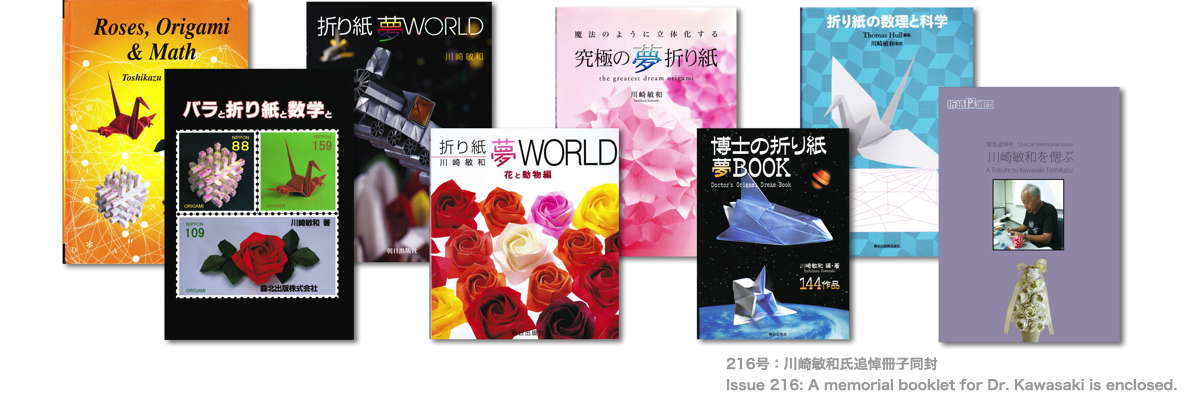
Toshikazu Kawasaki, counselor of the Japan Origami Academic Society, passed away on March 4, 2026, at the age of 70.
Kawasaki was a mathematician born in Nagasaki Prefecture in 1955, raised in Fukuoka Prefecture, and studied at the Faculty of Science and Graduate School of Kyushu University. He began creating origami around the time he entered university, and published numerous models, including the three-dimensional and magnificent rose (known as the “Kawasaki Rose”). He was also a researcher of the mathematics of origami.
Regarding the mathematics of origami, he received his doctorate in 1997 for his “Origami Crane Transformation Theory.” He is the first person to receive a doctorate for pure origami research. Furthermore, the “Kawasaki Theorem,” a theorem concerning the angle of folds in flat origami, is named after him.
His models were characterized by their unique and geometric ideas, typical of a mathematician, yet they are also full of the joy of folding paper. Examples include the beautiful spiral structure of the “Seashell,” cubes and octahedrons created using the “Iso-Area Folding” technique where the front and back of the paper appear the same, and the “Sakura Tama” (Cherry Blossom Ball), a model piece that embodies a cherry blossom using a dodecahedron structure. His philosophy is that “a good origami piece is one that you want to fold again and again,” which aligns with his ideal of “not fighting against the paper” and “not overlooking good shapes.”
He has been involved with the Japan Origami Academic Society since its inception, and initiated the society’s activities, such as the origami instructor system and the research journal “The Science of Origami.” He made significant contributions to society’s activities as a board member for many years, and later as a counselor after retiring from the board in 2021. He published numerous models in the “Origami Tanteidan” magazine and served as the editor-in-chief for Chapter 4, “The Mathematics of Origami,” of the “Origami Dictionary” (Asakura Publishing), which was compiled by the association and published in 2024.
Even in recent years, his enthusiasm for creation and research, and his desire to mentor younger generations, remained undiminished, and he continued to produce new models. His cheerful and unpretentious personality, along with his works, was loved by origami enthusiasts worldwide, and his untimely passing is truly regrettable.
(March 9, 2026, Written by: Jun Maekawa, Translation: Marcio Noguchi)